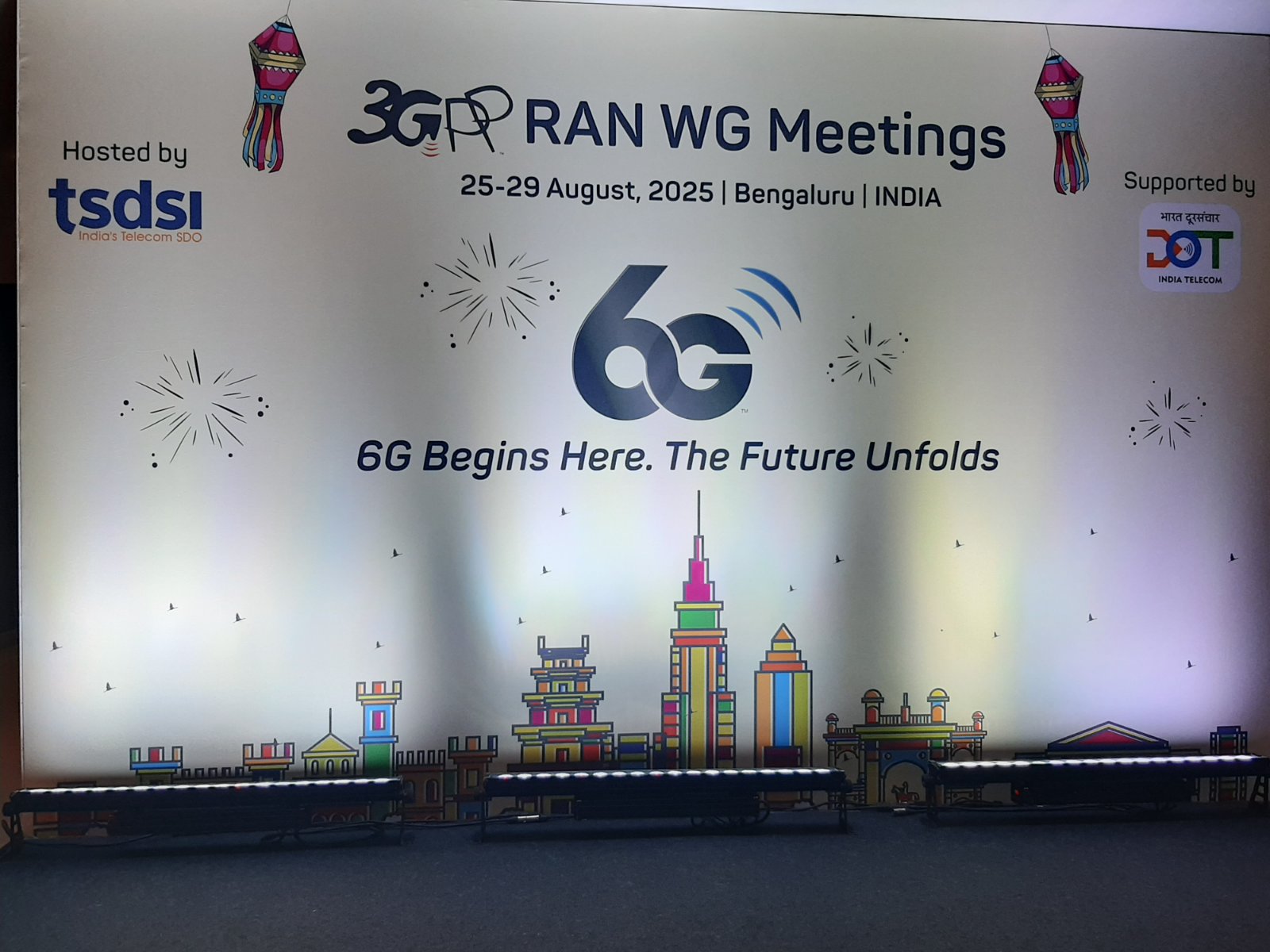
The 3GPP RAN1 meeting has delivered the first official agreement for 6G: the downlink will continue with CP-OFDM (Cyclic Prefix OFDM), while the uplink will use DFT-s-OFDM. This outcome was widely shared across the industry as a milestone moment — the first concrete step in defining the 6G physical layer.
On the surface, the news seems “happy”: stability, continuity, and backward compatibility are guaranteed, giving operators and vendors a smoother migration path from 5G.
However, as telecom researcher Spyridon Louvros (who was present in the room) explained, the story is more complex. Other candidate waveforms, including ZAC OTFS (Zero-Autocorrelation Orthogonal Time Frequency Space), were strongly presented and supported, particularly after the last plenary in 2025. Proposals from companies such as Jio Platforms Limited (JPL) highlighted ZAC as a potential alternative or complementary solution for 6G.
The final agreement in RAN1 was shaped less by outright rejection of these waveforms and more by what Louvros described as a “provisional lack of sufficient simulations”. In fact, the phrasing of the agreement itself leaves the door open: “new waveforms are not precluded.”
The first 6G agreement is a milestone, but it should be treated with caution. CP-OFDM and DFT-s-OFDM will certainly play a role in 6G, but if 6G is to live up to its promise, the industry must go beyond comfort and continuity. New waveforms, such as ZAC OTFS, may yet prove essential in defining the true identity of 6G.
Visit here the technical article of Keith Dyer in
https://the-mobile-network.com/




 3 minutes

