Project
Company: MCNS | Mobile network operator modernisation project
5G-Advanced NSA to SA modernization
Description
MCNS undertook the technical and techno-economic assessment of modernising an established Release 15 5G NSA network to a 5G-Advanced Rel.16 SA deployment, including the evolution from 4T4R radio systems to 32T32R and 64T64R massive-MIMO active antenna systems. The project connected the coverage and traffic requirements with the investment needed in the RAN, 5G Core, transport and operational environment. Its purpose was to identify a deployable migration path and determine where each antenna configuration could deliver sufficient operational and commercial value to justify its cost.
The assessment examined the existing LTE anchor and EPC dependencies, the readiness of the NR layer for standalone operation, and the equipment and software changes (including optional features) required for the target architecture. MCNS evaluated coverage improvement, usable busy-hour capacity and service continuity together with implementation cost, integration effort and investment exposure. The resulting recommendation addressed both the technical feasibility of SA introduction and the sequence in which the operator should commit capital.
The target 5G-Advanced baseline is Release 18, with individual features subject to verified vendor, software and device support [1]. The project therefore separated architecture migration from radio modernisation. A matched-radio SA case was retained as the control: changing NSA to SA alone was not assumed to increase RF coverage or spectral efficiency.
Coverage requirements vs. users
MCNS assessed coverage against an explicit service requirement rather than the visibility of an NR reference signal alone. The evaluation considered downlink quality, uplink reach and the ability of compatible terminals to establish and sustain service. The actual project acceptance plan would also verify SA control-channel reach, SSB and PRACH coverage, indoor penetration and busy-hour user performance. These additional conditions are not asserted by the simplified outdoor example below.
Figure 1 uses example raster-based planning analysis across a 100 km² region containing nine existing three-sector sites. Sites are modernised in a fixed centre-first sequence; no new sites or spectrum are added. Coverage is counted once per 100 m pixel, avoiding the double counting that would arise from simply summing cell footprints. The second panel converts additional serviceable area into potential user opportunity using a uniform density of 180 addressable users/km². These are potential serviceable users, not forecast acquisitions or simultaneous users.
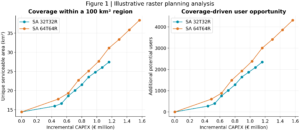
Figure 1. Illustrative planning-model results. Left: unique outdoor serviceable area versus incremental program CAPEX. Right: additional potential users relative to the retained NSA 4T4R baseline. The first upgrade includes the shared SA enabling cost.
Capacity improvement and the performance available to each user
The capacity study kept the C-Band carrier bandwidth and downlink time allocation constant. This separates radio improvements from a change in spectrum resources. The baseline includes the NR carrier of the Release 16 NSA system; additional LTE anchor capacity is excluded consistently. The assessment therefore does not claim an end-to-end throughput gain against NSA dual-connectivity operation that also aggregates LTE user-plane capacity.
The 32T32R and 64T64R cases introduce larger assumed serving-array gains and higher aggregate MU-MIMO scheduling capability. Realized spatial multiplexing depends on SINR, channel correlation, user separation, CSI accuracy, terminal capabilities and traffic. Four receive branches at a terminal do not become 32 or 64 receive branches because the base station changes. Aggregate sector layers may be distributed across multiple users.

Figure 2. Illustrative numerical capacity simulation. Left: aggregate capacity across 27 sectors versus program CAPEX. Right: incremental average throughput per active user at a fixed network load of 540 users. This is a resource-sharing proxy, not a guaranteed subscriber speed.
Techno-economic assessment and investment risk analysis
The CAPEX model included shared SA enablement and the site-specific radio investment. Investment risk was assessed as the possibility that the deployed network would fail to generate the cash benefit needed to recover the committed capital. A technically successful upgrade can still destroy value if traffic grows more slowly than forecast, SA-compatible devices remain scarce, customers do not adopt the intended services or installation costs exceed the original budget. Risk analysis therefore extended beyond a technical compliance score.
Demand and revenue risk included the conversion of additional coverage into paying customers, contribution margin, FWA take-up, mobile-data growth and displacement of existing revenue. Additional Mbps were not treated automatically as billable revenue. The business case distinguished cash contribution from newly reached users from avoidable expenditure or retention benefits on the existing footprint, so the same customer benefit was not counted twice.
Delivery and cost risk included structural reinforcement, power upgrades, transport expansion, software licensing, integration delays, supplier lead times and long-term support. Performance risk covered the gap between advertised MU-MIMO capability and realised busy-hour gains, including CSI ageing, calibration errors, poor spatial separability and uplink limitations. Service-continuity risk included voice, emergency access, EPS fallback, mobility and rollback readiness. Operational risk included dual-running costs, skills, fault isolation, security and dependence on vendor-specific management or interfaces.
MCNS would translate these exposures into a quantified investment model and a decision register. Each material risk requires an accountable owner, evidence needed before capital release, a mitigation action and a residual exposure. Stage gates allow the operator to fund a limited pilot, review measured coverage and loaded-sector results, and release the next tranche only when the corresponding technical and commercial conditions are met.
MCNS project technical reports and deliverables were
- Existing NSA network baseline and migration-readiness assessment covering RAN, LTE anchor, EPC, transport, sites and operational dependencies.
- Target Release 18 SA architecture and service-continuity plan, including 5GC integration, subscriber migration, voice, emergency access and EPS interworking.
- 4T4R, 32T32R and 64T64R radio-option assessment covering array gain, MU-MIMO, CSI and SRS configuration, calibration, processing and site readiness.
- Coverage planning and population-opportunity assessment, distinguishing unique serviceable area, addressable users, expected customers and busy-hour active users.
- Capacity and traffic assessment, including loaded-sector performance, per-user resource sharing and MBB–FWA coexistence.
- Technical validation and acceptance plan with feature prerequisites, representative test devices, repeatable measurements, rollback conditions and deployment gates.
- CAPEX and incremental OPEX model, investment scenarios, NPV sensitivity and quantified downside analysis.
- Modernization risk register covering commercial, technical, delivery and operational exposures, accountable owners and mitigation evidence.
- Consolidated techno-economic report and phased modernisation recommendation, including priorities for 32T32R, 64T64R, retained assets and further investigation.
Technical references